

Tanker Strikes Docked Riverboat at the Port of New Orleans: How Maritime Law Handles Passenger Injury Claims
Nov 13, 2026
Tanker Strikes Docked Riverboat at the Port of New Orleans: How Maritime Law Handles Passenger Injury Claims
By Joshua Rubenstein, Louisiana Personal Injury Attorney | Blake Jones Law Firm, LLC | Licensed in Louisiana, Texas, Georgia, Washington and Alaska
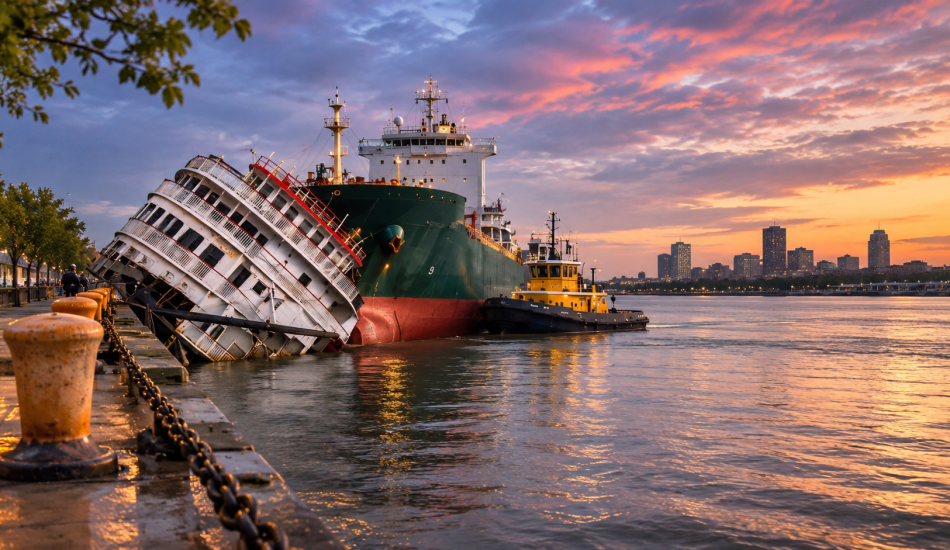
 On the afternoon of Friday, November 13, 2026, a tanker struck the riverboat American Heritage while it was docked at the Port of New Orleans, according to WWL-TV. Federal maritime law will decide who answers for any injuries, and under a rule the Supreme Court announced in 1895, a moving vessel that hits a stationary one begins the case presumed to be at fault.
The Port has not confirmed how many people were hurt or what caused the collision, and this post doesn’t try to answer either question. As a Louisiana attorney who handles maritime cases, I can explain how claims like this one are built once the facts come in, who can be held responsible, and which deadlines start running against passengers and crew right away. Everything below about the incident comes from news reports published on November 13, and it will change.
What do we know so far about the collision?
WWL-TV reported that Port of New Orleans spokesperson Kimberly Curth said a cruise-style boat with up to 129 people aboard was struck by a tanker around 12:30 p.m. near the Crescent City Connection. Port NOLA Harbor Police, the New Orleans Fire Department, the New Orleans Police Department, the Coast Guard and emergency medical crews responded, and passengers were taken into the Port’s administration building for triage.
WDSU identified the vessels as American Cruise Lines’ American Heritage and a tanker it called the Atlantic Asphalt, and reported that the American Heritage had docked about two hours earlier to begin letting passengers off. The Port said the number of injuries and the cause were still unconfirmed.
Its statement called the event an “allision.” That word has a specific meaning in maritime law: a moving vessel striking a stationary object, as opposed to a collision between two vessels that are both moving. The label isn’t a finding of fault. It does suggest the Port is describing the riverboat as stationary.
Whose law applies to an injury aboard a vessel docked on the Mississippi?
Federal maritime law. The Mississippi at New Orleans is navigable water, so an injury aboard a vessel there is a maritime tort, and the rules come largely from federal maritime law rather than from Louisiana’s Civil Code. Those claims can be filed in the Eastern District of Louisiana or, in many cases, in Louisiana state court.
Passengers and crew fall under different regimes. A passenger sues in general maritime negligence, and the Supreme Court has held that a shipowner owes those lawfully aboard “reasonable care under the circumstances of each case.” Kermarec v. Compagnie Generale Transatlantique, 358 U.S. 625 (1959). Crew members are covered by the Jones Act, which I address near the end.
Is a tanker presumed at fault when it hits a docked vessel?
Usually, and that presumption can decide a case. In The Oregon, 158 U.S. 186 (1895), the Supreme Court held that when a moving vessel strikes an anchored one, the moving vessel is presumed at fault and must prove it wasn’t. The logic is simple. A vessel tied up at a dock can’t cause a collision by itself.
If the reports that the American Heritage was docked hold up, I’d expect the same reasoning to shape this case. The tanker’s owner would then have to come forward with an explanation. That’s a presumption, not a verdict. The owner can try to rebut it, and liability can still be divided among several parties.
Who else can be responsible besides the tanker?
That depends on facts nobody has yet. In vessel cases, the list of potentially responsible parties often includes:
- The tanker’s owner and operator, and any charterer that controlled its movements
- Any pilot or tug company involved in moving the tanker
- The riverboat’s owner, if its mooring, crew response or evacuation fell short of the duty of reasonable care
Naming the right defendants early matters, because the evidence sits with each of them and none will volunteer it.
What deadlines apply to a passenger injury claim?
Three clocks can apply, depending on who the defendant is.
- Three years. For most maritime injury suits, 46 U.S.C. § 30106 sets a three-year limit from the date the claim arose. That usually governs claims against the tanker’s side, since a passenger never signed a contract with them.
- The ticket contract. A cruise line’s ticket can set its own deadlines, but under 46 U.S.C. § 30508, the owner of a vessel carrying passengers between U.S. ports can’t allow less than six months to give notice of a claim or less than one year to sue (longer for some small passenger vessels). Read the ticket. The deadline against the cruise line may be a fraction of three years.
- The limitation action. Under the Limitation of Liability Act, a vessel owner has six months after written notice of a claim to file a federal action asking a court to cap its liability. 46 U.S.C. § 30529. Once the owner files and funds the action, other suits against it stop while the federal proceeding runs.
So what a claimant sends, and when, is a strategy decision. Don’t sign or send anything blind.
What should passengers do now to protect a claim?
Our office at the Hancock Whitney Center on Poydras Street is a short drive from the Port, and the first steps are the same wherever you are. Start with the things only you can do:
- Get medical care and tell the provider the injury happened aboard the vessel.
- Keep the ticket, booking confirmation and boarding documents. The contract’s deadlines are in there.
- Photograph injuries, damaged belongings and the vessel, and get names and numbers for other passengers and crew.
- Write down what you saw and felt while it’s fresh.
- Don’t sign a release or give a recorded statement to the cruise line or an insurer before you know what it gives up.
Then there’s our side. In more than 50 years and over $500 million recovered for our clients, I’ve learned that in a vessel case the proof that decides liability sits on the vessels, not with the injured person. The first step is a preservation letter demanding:
- Voyage data recorder and bridge audio
- AIS and radar tracking data
- Pilot, master and mooring logs
- Crew training and emergency-response records
- Incident reports and the passenger manifest
Some of that data overwrites itself on a loop. It doesn’t wait for a lawsuit.
What about crew members hurt in the collision?
Crew are a different case. A seaman injured in the service of a vessel can bring a Jones Act claim against the employer under 46 U.S.C. § 30104, and is owed maintenance and cure whether or not the employer was at fault. We explain how those claims work on our New Orleans maritime accident lawyer page.
Frequently Asked Questions About New Orleans Maritime Cases
Is the tanker automatically liable?
No. If the riverboat was docked, the tanker is presumed at fault and has to rebut the presumption. It can try, and fault can be shared, so the answer depends on what the data recorders, logs and witnesses show.
Can a passenger also sue the cruise line?
Possibly. The question is whether the cruise line met its own duty of reasonable care, including how it moored, how it responded after the impact and how it got people off. Nothing in the reports I’ve read says either way.
Who investigates a collision like this?
The Coast Guard investigates marine casualties, and the National Transportation Safety Board can investigate major ones. Their findings help, but they don’t decide a civil claim.
Do I need a lawyer who handles maritime cases?
Maritime claims come with ticket deadlines, limitation proceedings and federal procedure that ordinary injury cases don’t. If you have questions about a maritime injury, call us and we’ll tell you straight whether you have a claim.
On the Land, on the Water or on the Roadways of America — We Will Fight for You.
Injured on a vessel in Louisiana? Get a free consultation today. Call 504-500-1234 or reach out online. No fee unless we win your case. Contact Blake Jones Law Firm →
About the Author
Joshua Rubenstein Louisiana Personal Injury Attorney at Blake Jones Law Firm, LLC
Joshua Rubenstein is an attorney at Blake Jones Law Firm, LLC, where he represents injured workers and accident victims throughout Louisiana. His practice focuses on asbestos and mesothelioma litigation, complex personal injury and maritime cases, and commercial trucking accidents. Joshua is committed to fighting for the full compensation his clients deserve and providing personalized attention to every case he handles.
View Profile | Facebook | LinkedIn
Sources
- Thomas Planchet, WWL-TV, Tanker crashes into boat with approximately 129 passengers on Mississippi River near CCC (Nov. 13, 2026)
- WDSU, New Orleans officials respond to boat collision on Mississippi River involving cruise ship (updated Nov. 13, 2026)
- The Oregon, 158 U.S. 186 (1895), opinion
- Kermarec v. Compagnie Generale Transatlantique, 358 U.S. 625 (1959), opinion
- 46 U.S.C. § 30106; 46 U.S.C. § 30529; 46 U.S.C. § 30508; 46 U.S.C. § 30104
New Orleans
Hancock Whitney Center
701 Poydras St # 4100,
New Orleans, LA 70139

Request Your
Free Consultation
Fields Marked With An "*" Are Required
"*" indicates required fields

Copyright ©2026 Blake Jones Law Firm, LLC • All Rights Reserved.
*Images are obtained under license from Canva and other third-party stock image providers, with attribution included where required.