|
|
Last
Modified on
Aug 28, 2026
By Joshua Rubenstein, Louisiana Trucking Injury Attorney | Blake Jones Law Firm, LLC | Licensed in Louisiana, Texas, Georgia, Washington and Alaska
A broker in Nevada hired a carrier to haul a load, and that carrier never drove it. Instead, it handed the load off to a second carrier, off the books, and that second carrier put a driver behind the wheel who had never been vetted by anyone in the chain. That driver crashed, and someone died.
That’s double brokering, and it isn’t just a paperwork technicality. It’s how an unqualified driver, in a truck nobody checked, ends up sharing a lane with your family on the interstate, and until recently, almost nobody paid for it when things went wrong. Two rulings handed down this year say that’s changing.
What Double Brokering Actually Is, and Why It’s Different From Legal Freight Brokering
Legitimate freight brokering is simple: a broker matches a shipper’s load with a licensed motor carrier, and that carrier hauls it. Federal broker regulations at 49 C.F.R. Part 371 require the broker to keep records of who moved the freight.
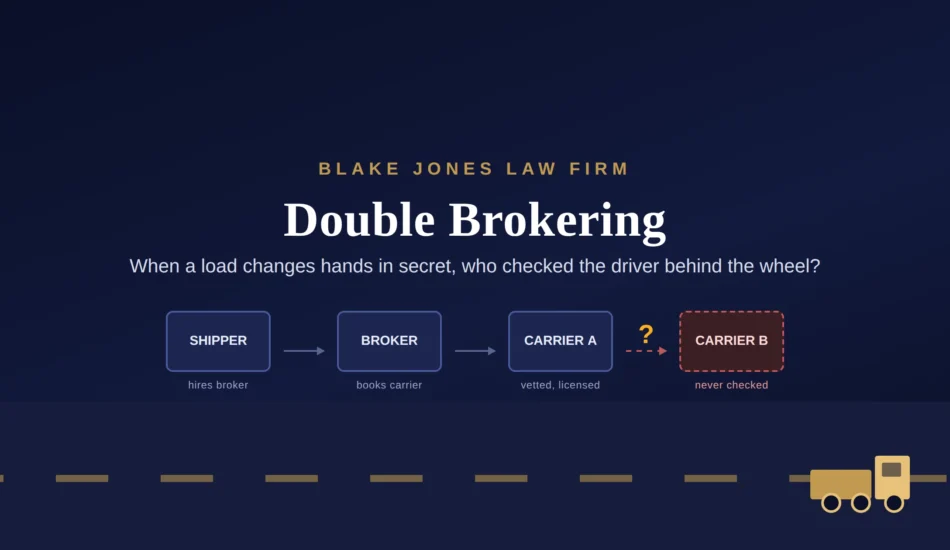
Double brokering breaks that chain on purpose. A carrier accepts a load, then quietly re-brokers it to a second carrier, sometimes a third, without telling the original broker or shipper who’s really driving the truck. Nobody upstream ever checks the actual driver’s safety record, hours-of-service history, or insurance. The paperwork says one carrier is responsible. The truck on the highway belongs to someone else entirely.
Fraud rings have turned this into a business model, stealing motor carrier identities and DOT numbers to collect payment for loads they never intend to safely deliver. But the version that should worry every motorist isn’t the invoice fraud. It’s what happens to safety oversight when three or four companies each assume somebody else already checked the driver.
A Nevada Broker Knew Its Carrier Was Re-Brokering Loads. A Federal Court Said That Wasn’t Good Enough.
In July 2022, a crash outside Las Vegas killed one person and injured another. The load had passed from a broker, AONE Brokerage Company, to Lucky Transport, a carrier that lacked its own broker authority but subcontracted the load anyway to a second carrier, GRK Transport. GRK put Bhupinder Singh behind the wheel, a driver who had previously worked for Lucky and was still using the company’s fuel card and a trailer Lucky had rented, according to reporting from Gain Consulting on the case.
AONE and the plaintiff, Daniel Hardy, each moved for summary judgment. On August 11, 2026, Judge Anne Traum denied both motions in Hardy v. Singh, No. 3:23-cv-00207 (D. Nev.).
According to FreightWaves’ reporting on the ruling, the court found evidence that AONE’s own owner admitted knowing Lucky had used third-party carriers on prior loads, and that continuing to hand Lucky business anyway could be unreasonable, because illegal double-brokering “can put more high-risk drivers on the road.”
That’s not a technical ruling about contract law. It’s a court recognizing that a broker who keeps feeding loads to a carrier it knows is re-brokering has made a choice about who gets vetted and who doesn’t.
The Fifth Circuit: A Lease on Paper, or Not, Still Makes You the Statutory Employer
The second case goes back to a fatal crash in South Texas. While driver Satnam Singh Lehal was on his way to Laredo to pick up cargo for Adient US, his tractor-trailer jackknifed, crossed into oncoming traffic, and killed Lyndon Dean Meyer.
Adient had hired Penske Logistics to move its freight. Penske never hired Lehal and never owned his truck. Instead, Penske outsourced the job through its affiliate broker, Penske Transportation Management (“PTM”), to a carrier called Liberty Lane. Liberty Lane’s affiliate broker then hired a third carrier, OK Trans, which supplied the truck and put Lehal behind the wheel.
A federal district court held that Penske wasn’t Lehal’s statutory employer because Penske’s own arrangement ran only to Liberty Lane, not to OK Trans or Lehal, and that the family’s negligent-hiring claim against PTM was preempted by the FAAAA. The Fifth Circuit reversed both rulings on August 4, 2026, in Crane v. Penske Transportation Management, L.L.C., No. 25-40012 (5th Cir. 2026).
On the vicarious-liability question, the court leaned on decades of its own precedent under 49 C.F.R. §§ 376.11, 376.12, and 376.22, the federal regulations governing how one motor carrier leases equipment from another. Under that framework, a carrier that takes on “control and responsibility for the operation” of leased equipment becomes the driver’s statutory employer, whether or not the paperwork was ever formalized. Simmons v. King, 478 F.2d 857, 867 (5th Cir. 1973). Penske’s agreement obligated Liberty Lane to move Adient’s freight on Penske’s behalf, and Liberty Lane in turn held the truck under an arrangement with OK Trans. That two-step chain was enough. The court held that Penske’s assumption of control made it Lehal’s statutory employer regardless of whether Penske and Liberty Lane ever complied with the regulations’ formal requirements.
On the broker side, the district court had dismissed the negligent-hiring claim against PTM because the FAAAA preempted it. While the appeal was pending, the Supreme Court decided Montgomery v. Caribe Transport II, LLC, 608 U.S. ___ (May 14, 2026), holding that the FAAAA’s safety exception preserves exactly this kind of state-law negligence claim against brokers, as I wrote when the Supreme Court handed down that ruling. Montgomery wiped out the district court’s reasoning, and the Fifth Circuit reversed the PTM dismissal along with it.
Four companies stood between the shipper and the truck driver behind the wheel, yet none of the companies in this tragic chain of events personally checked that driver out. That’s the quintessential double brokering case.
This substance-over-form approach isn’t unique to the Fifth Circuit. In an unpublished 2020 Wisconsin appeals decision, Rogers v. Great West Casualty Co., No. 2019AP672 (Wis. Ct. App. Dec. 10, 2020) (per curiam), the court revived a claim against a company registered with federal regulators as a broker, holding a jury could find it had acted as the “motor carrier” for that specific shipment under 49 U.S.C. § 13102 and 49 C.F.R. § 371.2(a). The opinion is unpublished, per curiam, and binds no court outside a narrow Wisconsin procedural exception, so it isn’t authority here. But the underlying principle travels: what a company calls itself on its FMCSA paperwork doesn’t decide who answers for the wreck.
Why This Puts Every Driver on the Roadways of America at Risk
Double brokering doesn’t happen in isolation. It thrives inside a regulatory system that can’t keep up with how easy it’s become to fake compliance. Take electronic logging devices, the black boxes that are supposed to stop drivers from falsifying hours behind the wheel. Most ELD providers don’t build their own software. They buy “white-labeled” code from a single underlying developer, slap their own name on it, and self-certify the relabeled product to FMCSA as if they built it themselves. The United States has 1,020 self-certified ELD providers as a result, compared to 42 in Canada, where every provider must pass third-party certification, according to Freight Caviar’s reporting on the problem. Mark Hazelwood, chair of ELD provider Assured Telematics, has described that self-certification process, more bluntly, as “grading your own papers.”
FMCSA has pulled 95 ELDs from its registry since January 2025. One vendor whose device got revoked told Freight Caviar it had bought the software from another company and registered it “to make money,” comparing the market to drug dealing: “There’s a demand for drugs…That’s why there are suppliers.” Arizona inspectors found 281 ELD-tampering violations from just 115 driver inspections.
The bottom line: a driver hauling a re-brokered load, running a falsified log on a device nobody properly certified, isn’t an edge case. It’s what happens when four companies each assume the one before them did the vetting, and the regulatory system doing the certifying is built on the honor system.
What This Means If You Were Hurt by a Re-Brokered Load
Our firm has built cases against multiple layers of the freight chain before. Blake Jones and I tried Knoten v. Westbrook, 193 So.3d 380 (La. App. 4th Cir. 2016), one of the first Louisiana verdicts to hold a freight broker and shipper vicariously liable for a trucking accident. That verdict exceeded $90 million. Louisiana’s comparative fault framework under La. Civ. Code art. 2323 means there’s no reason to stop at the name on the truck door.
If you walked into my office in New Orleans tomorrow with a crash involving freight that changed hands more than once, here’s what I’d be chasing:
- The original broker’s records showing which carrier it thought was hauling the load
- Any evidence that a carrier subcontracted, leased, or “trip-leased” the freight without disclosure, and whether a written lease under 49 C.F.R. §§ 376.11–.12 ever existed
- The re-brokered carrier’s safety rating, insurance, and driver qualification file, or the lack of one
- Communications showing who knew the load had been handed off, and when
- The ELD data itself, since a white-labeled device from an unfamiliar provider is worth checking
These cases turn on paper trails that fraud rings and chameleon carriers work hard to erase, so evidence needs to be locked down fast.
Frequently Asked Questions
Is double brokering illegal?
Yes, when a carrier re-brokers a load without disclosing it or without holding broker authority itself, it violates federal broker regulations under 49 C.F.R. Part 371. It can also expose the original broker to liability if it knew, or should have known, the practice was happening.
Can I sue a broker if the truck that hit me wasn’t the carrier the broker hired?
Possibly. Hardy v. Singh shows a broker can face liability for continuing to do business with a carrier it knew was re-brokering loads to others. I’d need to look at what the broker knew and when, but that’s exactly the kind of evidence these cases are won or lost on.
How many companies can end up responsible for one crash?
More than you’d think. In Crane v. Penske Transportation Management, four separate companies sat between the shipper and the driver who caused the wreck, and the Fifth Circuit let claims proceed against two of them. Don’t assume the name on the truck is the only one on the hook.
What can I do after a crash to protect myself from a double-brokered load?
If you’re ever in a position to do it safely, get the carrier’s DOT number off the cab door and photograph it before the truck leaves the scene. Here’s why that matters: the broker’s own paperwork typically names only the carrier of record, meaning the carrier the broker hired and holds responsible on paper. If that carrier illegally re-brokered the load to a second, unauthorized carrier, the truck and driver at the scene belong to that second carrier, and nothing in the broker’s file will show it. The DOT number on the cab door is often the only lead pointing to who was really driving. Don’t give a recorded statement to any insurer before talking to a lawyer, and call an attorney quickly. Broker and carrier records in these cases have a way of disappearing once everyone in the chain knows a lawsuit is coming.
Sources
- Crane v. Penske Transportation Management, L.L.C., No. 25-40012 (5th Cir. Aug. 4, 2026), opinion via Justia
- Montgomery v. Caribe Transport II, LLC, No. 24-1238, 608 U.S. ___ (2026), Supreme Court slip opinion
- Knoten v. Westbrook, 193 So.3d 380 (La. App. 4th Cir. 2016)
- Simmons v. King, 478 F.2d 857 (5th Cir. 1973)
- Rogers v. Great West Casualty Co., No. 2019AP672 (Wis. Ct. App. Dec. 10, 2020) (unpublished, per curiam)
- Hardy v. Singh, No. 3:23-cv-00207 (D. Nev. Aug. 11, 2026) (Traum, J.), docket via Justia
- Gain Consulting, Courts Crack Down on Double Brokering: Two Cases Every Freight Professional Should Know (August 19, 2026)
- FreightWaves, The list grows: 2 more cases proceeding on broker liability (2026)
- FreightWaves, Penske firms reversed twice on appeals, Montgomery a factor (August 2026)
- Freight Caviar, ELD Whack-a-Mole (August 12, 2026)
- Overdrive, Arizona logs 281 ELD-cheat OOS violations from just 115 driver inspections
- FMCSA, Broker and Carrier Fraud and Identity Theft
- 49 U.S.C. §§ 13102(2), 13102(14), 14102(a), 14501(c)(2)(A); La. Civ. Code art. 2323; 49 C.F.R. Part 371 (Brokers of Property); 49 C.F.R. §§ 376.2(e), 376.11–.12, 376.22 (leasing of equipment)