|
|
Last
Modified on
Aug 24, 2026
By Joshua Rubenstein, Louisiana Personal Injury Attorney | Blake Jones Law Firm, LLC | Licensed in Louisiana, Texas, Georgia, Washington and Alaska
Recognized by the National Trial Lawyers as a Top 10 Trucking Trial Lawyer, Joshua has spent nearly thirty years watching insurance companies find new ways to close a file instead of paying it.
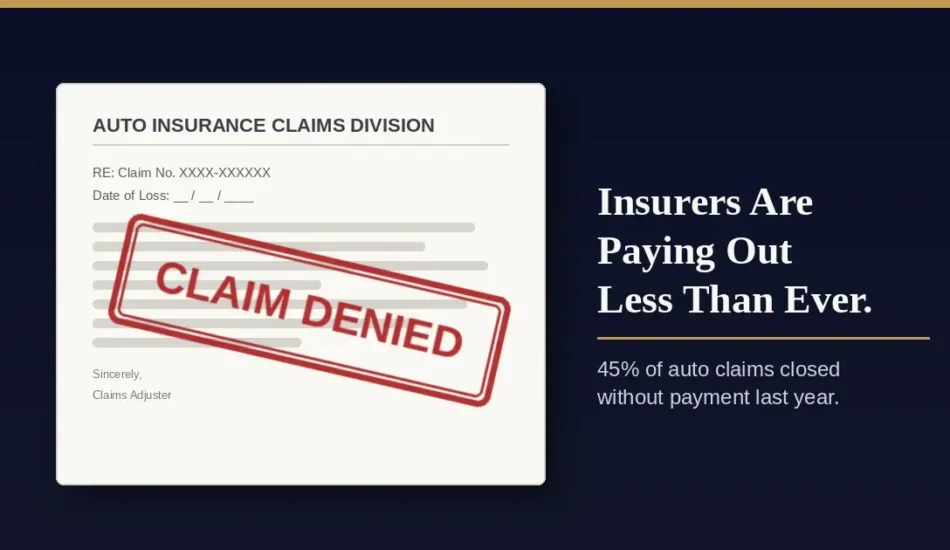
A Wall Street Journal analysis published this week found that auto insurers closed 45% of liability and medical claims last year without paying anything at all. A decade ago, that figure was closer to one in three. Car insurance is mandatory almost everywhere, including Louisiana, and the backstop drivers are required to buy is paying out less than it used to, not more.
Insurers Are Paying Fewer Claims. The Numbers Are Real.
The Journal’s analysis of thousands of company regulatory filings found that 45% of auto liability and medical claims resolved in 2025 closed without a payment, up from about 35% a decade earlier, according to the Wall Street Journal. Citybiz independently reported the same figures the same day, drawn from the same underlying data.
Not every closed file is a wrongful denial. Some claims close because another driver’s insurer covers the loss, because the damage sits below the deductible, or because the policyholder drops it. That distinction matters, and it’s a fair one.
But look at what stayed flat. Collision and comprehensive claims, the kind where you’re filing against your own policy for damage to your own car, held steady at roughly 24% unpaid over the same ten years. Liability and medical claims, the kind where you need someone else’s insurer to pay for what they did to you, moved from one in three unpaid to nearly one in two.
That gap is the whole story.
Some insurers posted sharper increases in no-payment rates than others, and drivers in Hawaii and California face roughly double the non-payment rate that drivers in Michigan do. Meanwhile, personal auto insurers paid out just 61 cents for every premium dollar collected last year, their lowest payout ratio since 2020.
That’s not a coincidence.
Why Are Insurers Closing More Claims Without Paying?
Ask the industry, and you’ll hear one story. Ask a consumer advocate, and you’ll hear another.
Insurers attribute much of the no-payment tally to claims another driver’s insurer already covered, claims customers withdrew, claims outside the policy terms, or damage below the deductible. State Farm has specifically pointed to higher deductibles, third-party claims, and new drivers who were never added to the policy, according to Repairer Driven News‘s reporting on the WSJ data. Jess Merten, Allstate’s head of property-liability, framed it as pricing discipline: “We have to pay what we owe, not a dollar more. The better we are in claims, the less that we have to charge customers.”
The trend line isn’t even across the industry. Per that same reporting:
- Liberty Mutual’s no-payment rate went from 29% in 2016 to 54% in 2025.
- Allstate’s went from 46% to 54%.
- State Farm’s went from 26% to 47%.
- Farmers’ went from 19% to 39%.
That’s not rounding error. That’s a policy.
Insurance rates keep rising, but the payouts go down. What does that mean? It means that insurance company profits rise and rise.
Douglas Heller of the Consumer Federation of America sees a different motive: “The industry uses claim lowballing and denials to wring extra profit out of customers who don’t have the resources or, in some states, the rights to fight back.” A separate, earlier study issued in April 2026 by Citizen Action of New York, built on Weiss Ratings research, found a similar pattern and quoted Weiss founder Martin Weiss on the incentive: insurers “make so much income from investing your premium dollars that it can create incentives for some to deny and delay payments.”
I don’t need a regulatory filing to know how this plays out. I’ve been on the other side of it myself.
A couple of years ago, my wife and I were rear-ended in Louisiana. We weren’t hurt, thankfully. But when we made a claim against the other driver’s insurer, the company denied it outright for “material misrepresentation,” because the parent who owned the policy had never disclosed the driver who hit us as a household driver. That’s the exact scenario State Farm cited above: a new driver never added to the policy. We hadn’t misrepresented anything. We were the injured party, and we still ended up with a denial letter over paperwork we had nothing to do with.
It’s Not Just Cars. Home Insurance Is Behaving the Same Way.
The Journal has reported the identical pattern in homeowners insurance. The five biggest home insurers, Allstate, State Farm, Liberty Mutual, USAA, and Farmers, collectively declined more than 44% of claims resolved in 2025, according to the same Wall Street Journal analysis.
Auto and home coverage are often sold by the same companies, adjusted under many of the same internal playbooks.
If your insurer got tougher on your roof claim, it got tougher on your car claim too.
What This Means If You’re Hurt in a Louisiana Car Accident
Louisiana requires drivers to carry only $15,000 per person and $30,000 per accident in bodily injury liability coverage, plus $25,000 in property damage, under La. R.S. 32:900. Those limits were already thin before this trend. In a serious wreck, they get exhausted fast, sometimes before the at-fault driver’s insurer even finishes questioning what it owes.
That’s where your own uninsured/underinsured motorist coverage comes in, and it matters more now than it did ten years ago. Louisiana law requires UM/UIM coverage on every auto policy unless you reject it in writing, on a form that meets specific statutory requirements, under La. R.S. 22:1295. If the at-fault driver’s insurer is now closer to a coin flip on whether it pays you in full, your own UM coverage may be the only real recovery left on the table.
Go back to the crash I described above. My wife and I weren’t hurt, so it never became more than a property damage headache. But swap in real injuries, and that denial letter over an undisclosed household driver stops being an inconvenience and becomes the reason a family gets nothing from the at-fault driver’s policy. Your own UM/UIM coverage is what stands in that gap. A lot of people don’t find out what they rejected, or what limits they picked, until they need it.
Louisiana also has a bad faith statute, and it changed recently. As amended effective July 1, 2024, La. R.S. 22:1892 requires an insurer to “adjust claims fairly and promptly” and to pay a claim within 30 days of receiving satisfactory proof of loss. When an insurer’s failure to pay is “arbitrary, capricious, or without probable cause,” the statute allows penalty damages on top of what’s owed, plus attorney fees.
That 30-day duty runs to the insurer’s own insured. It’s the statute that has your back when you’re fighting your own carrier, on your own UM/UIM claim, for example, not when you’re waiting on the at-fault driver’s insurer to pay a liability claim. Louisiana courts have held the statute’s specific payment-deadline penalty belongs to the policyholder, not to a third-party claimant with no contract with that insurer. Woodruff v. State Farm Ins. Co., 767 So. 2d 785 (La. App. 4th Cir. 2000).
That distinction changes how a claim gets fought. A denied UM claim is a statutory fight with a calendar built into it. A denied or lowballed liability claim against the other driver’s insurer is a fault-and-damages fight, built through your own evidence and, if it comes to it, a lawsuit against the at-fault driver, not through the bad faith statute. Knowing which fight you’re in, before you send a letter to the wrong company demanding the wrong thing, is exactly the kind of judgment call a lawyer makes for a living.
Louisiana also reduces your own recovery under comparative fault if a jury decides you share the blame, which is one more reason a denied or lowballed claim shouldn’t be handled alone. We’ve written before about how much you can recover after a Louisiana car accident and about the 2025 legislative changes that reshaped how fault gets divided.
Why an Attorney Matters More Now Than It Did a Decade Ago
Insurers didn’t get more aggressive by accident. They built claims-review systems, underwriting rules, and AI-assisted fraud screens to close more files. Claimants who show up alone, without the same tools, are exactly who those systems are built to process quickly and pay as little as possible.
I’ve spent nearly thirty years watching that gap decide cases before a client even calls me.
An attorney does three things an insurer is betting you won’t do yourself:
- Read the denial letter against the actual policy language, not the summary the adjuster gave you over the phone.
- Sort out whether you’re fighting your own insurer, where the 30-day bad faith deadlines under La. R.S. 22:1892 apply directly, or fighting the at-fault driver’s insurer, where they don’t.
- File suit and put the claim file in front of a jury when the insurer won’t move.
None of that costs you anything up front. We work on contingency. No fee unless we win.
If Your Claim Was Just Closed Without Payment, Here’s What I’d Tell You to Do
- Get the denial or closure reason in writing, citing the specific policy provision relied on.
- Don’t accept a verbal explanation as the final word. Insurers routinely give a softer reason on the phone than what ends up in the file.
- Ask about your own UM/UIM coverage right away if the at-fault driver’s insurer is the one denying or lowballing you.
- Keep every piece of correspondence and every deadline date. The bad faith penalty depends on the calendar.
- Call before you sign anything or accept a quick check. A fast, low offer is often the clearest sign a bigger number is available.
Frequently Asked Questions
Does a 45% claim denial rate mean my accident claim will probably be denied?
No, and it shouldn’t be read that way. Many closed-without-payment files involve claims another insurer covered, damage under the deductible, or withdrawn claims, not wrongful denials. What the trend does show is that insurers are scrutinizing claims harder than they were a decade ago, which is exactly why a documented, well-supported claim matters more now.
What can I do if my own insurer closes my Louisiana car accident claim without paying?
Get the written reason for the closure and compare it against your actual policy. If the closure looks arbitrary, capricious, or without probable cause, Louisiana’s bad faith statute, La. R.S. 22:1892, may entitle you to penalty damages and attorney fees on top of what you were owed. Call before the statutory deadlines pass.
Is Louisiana’s bad faith insurance law enough protection on its own?
Only if you’re the one insured under that policy, and even then, rights on paper aren’t the same as money in hand. La. R.S. 22:1892’s 30-day deadline and arbitrary-and-capricious penalty protect you against your own insurer, on a UM claim for instance, not against the at-fault driver’s insurer. Proving a denial was arbitrary or capricious takes the claim file, the internal timeline, and usually a lawsuit. That’s not something most people are equipped to build without help.
Should I keep uninsured/underinsured motorist coverage even though it costs more?
Yes. With auto liability claims closing unpaid nearly half the time, the driver who hit you may not have coverage that pays for what happened. Your own UM/UIM coverage can be the difference between a real recovery and nothing, and Louisiana law requires it be offered unless you reject it in writing.
Do I need a lawyer for a minor accident, or just for serious injuries?
Call and let me look, even if it seems minor. Louisiana’s minimum liability limits are thin, insurers are denying more claims across the board, and a “minor” claim today can turn into a fight over coverage tomorrow if symptoms develop later or the insurer disputes fault.
For more than fifty years, on the land, on the water, and on the roadways of America, our firm has fought for injured people. If your insurer, or the other driver’s, just told you it isn’t paying, call before you accept that answer.
On the Land, on the Water or on the Roadways of America — We Will Fight for You.
Sources
- Jaclyn Jeffrey-Wilensky and Jean Eaglesham, If You Get in a Car Crash, the Risk Is Growing Your Insurance Won’t Pay, The Wall Street Journal (August 2026)
- Win Warfield, Auto Insurers Close 45% of Liability and Medical Claims Without Payment, citybiz (August 10, 2026)
- Teresa Moss, WSJ Finds Auto Insurers Refused to Pay 45% of Liability and Medical Claims Last Year, Repairer Driven News (August 13, 2026)
- Citizen Action of New York / Weiss Ratings, Auto Insurance Companies Denying Half of All Auto Claims Without Payment (April 2026)
- The Wall Street Journal, homeowners-insurance analysis, as reported by AOL (2026)
- La. R.S. 32:900, Louisiana Legislature
- La. R.S. 22:1295 (uninsured motorist coverage), Louisiana Legislature
- La. R.S. 22:1892, as amended eff. July 1, 2024, Justia Louisiana Revised Statutes
- Woodruff v. State Farm Ins. Co., 767 So. 2d 785 (La. App. 4th Cir. 2000)
- La. Civ. Code art. 2323